Category: News


IIS informs with deep regret of the death of Dmitry Semenovich Chereshkin, one of its founders

Dmitry Semenovich Chereshkin was one of the founders of the Institute of the Information Society. From the very beginning, he greatly influenced the IIS strategy and throughout the entire period of its existence since 1998 has been actively involved in its work. Since 1999, he has invariably been a member of the Editorial Board of the scientific and analytical journal “Information Society” published by our institute and made a huge contribution to its development. All these long years we have been bound by warm and friendly relations.

Dmitry Semenovich was born in 1931. After graduating from the Bauman Moscow State Technical University, he received the specialty of an engineer for the automation of radio devices (1956). Then he worked at the Strela Design Bureau, engaged in the design of homing heads for various types of missiles. In the mid-1960s, he worked as a teacher at the Forestry Institute, taught courses on nonlinear automatic systems and automated control systems. Then he worked as Deputy Director for Science of the Main Computer Center of the Ministry of Forestry.

Since 1976 he worked at the Institute for System Analysis of the Russian Academy of Sciences (formerly VNIISI), heading (since 1997) the laboratory for system analysis of informatization processes. He is one of the leading ideologists of the processes of informatization of the Russian society, a responsible executor and scientific supervisor of many research projects of theoretical and applied plans in the field of computerization and automation of large organizational and control systems.

Under his scientific guidance and with direct participation in 1990-2000, the main theoretical and methodological provisions of the strategy of the country’s transition to the information society have been developed, which determined the main directions of the state policy of informatization carried out by the Ministry of Communications of Russia. D.S. Chereshkin made a great contribution to the development of the Concept of State Information Policy, approved by the relevant Committee of the State Duma of the Russian Federation.

In 1995, a team headed by prof. Chereshkin developed the Concept of Information Security of the Russian Federation, which formed the conceptual basis of the Information Security Doctrine of the Russian Federation adopted in 2000. He solved complex methodological problems of assessing the effectiveness of information security systems, assessing the risks of information security breaches. The results of these works have received wide recognition and practical implementation in the information security system of the Central Bank of Russia. Prof. Chereshkin’s great achievement is the creation of a new specialty of the Higher Attestation Commission – “Information Security”.

D.S. Chereshkin was directly involved in the formation and functioning of the Russian Academy of Natural Sciences: he created the section “Informatics and Cybernetics” and became its chairman, and was soon elected vice-president of the Academy. He also was the chairman of the board of National Association of Electronic Commerce Participants.

Besides, he was a member of the expert councils of the Higher Attestation Commission of Russia and the RFBR, in which he took an active part, as well as member of dissertation councils of the Institute for System Analysis of the Russian Academy of Sciences and the Academy of the Ministry of Internal Affairs. More than 10 Ph.D. theses were defended under his supervision. He is author of over 250 scientific papers recognized by the scientific community.

Doctor of technical sciences, professor, full member of the Russian Academy of Natural Sciences, D.S. Chereshkin is widely known as a prominent specialist in the field of system analysis of information processes. He was a member of the International Group on Information Security in Telecommunications, an expert of the EU Data Protection Committee, and Deputy Chairman of the Expert Council under the Information Security Committee of the State Duma of the Russian Federation.

The IIS team will forever preserve the bright memory of a wonderful person and an outstanding figure in the Russian information society.

   

Institute of the Information Society congratulates colleagues and partners with the upcoming year 2022

Dear colleagues, partners, and friends!

The IIS team congratulates you on the upcoming year 2022 and wishes you new successes, new hopes and achievements in the new year.

We wish you all strong health, personal happiness and optimism!

Happy holiday and fruitful vacations!


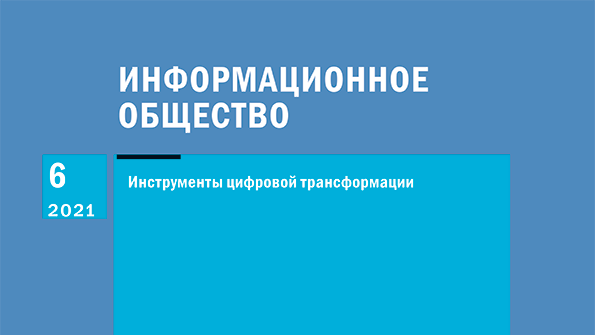
The sixth issue of the Information Society journal for 2021 is published

“Destitutis ventis remos adhibe” – people said in ancient Rome, that is, “When the wind has died down, take the oars”. Having survived millennia, this formula, which urges us not to lose heart under any circumstances, turned out to be very timely. For two years now, the epidemic has been limiting us, holding back momentum, stealing energy, and undermining optimism. But not everyone succumbs to this. Those who are persistent and not used to being discouraged, seek and even create new opportunities for development and a dignified life themselves.

For example, we responded very quickly to the challenge of fate by building and launching a digital platform for our journal. To say that it saved us time, effort and money is to say nothing. The journal not only survived – it reached a new level: we firmly fit into the schedule, the selection of materials and reviewing became stricter, the authors became more responsible, and the articles finally acquired unique digital identifiers. With more than 30 percent of the submitted work not going through the peer review sieve, our editorial portfolio is already full by May next year. So long live our paddles – digital technology!

In the latest issue of our journal, 11 articles were published, one of which marks our return to the practice of exclusive interviews under the heading “Leaders of the information society”. This time, Dean Lacheca, one of the leading analysts of the largest research and consulting company Gartner, shared his ideas. His interview was published in Russian and English. 10 articles are divided between the following headings:

  • Fundamental research in the field of information society
  • The digital economy
  • Education in the information society
  • Healthcare in the information society
  • Science and innovations in the information society
  • Information society and law
  • Information society and mass media
  • Sports and tourism in the information society

All the content of the issue is available on the digital platform of the journal.

In total, in the outgoing year, we published 49 materials, which have closed almost all the thematic sections. The only exception was “Culture in the information society”, and this is the gap that I would like to fill next year. The most popular was “Information society and law” (9 articles); it is followed by “Information society: policy and drivers”, “Education in the information society” and “Information society technologies” (five articles each); “Digital economy” and “Measuring the information society” (four articles each); “Fundamental research in the field of information society”, “Information society and state power”, “Science and innovation in the information society” (three articles each). The rest of the headings got one or two works. A new heading “Digital agriculture” has been introduced, which seems to us to be very promising.

The number of our authors was 68, and most of them naturally represented Russia. There were 44 Muscovites among them, authors from St. Petersburg – three, authors from Vladikavkaz, Vladimir, Dubna, Kazan, Petrozavodsk and Ryazan – two from each, and from Ekaterinburg and Tomsk – one from each. We were very pleased with the work of researchers from Australia, Azerbaijan, Belarus, Kazakhstan and the United States. We have never had such an international representation.

Among our authors there were 18 doctors of sciences, 31 candidates of sciences, 21 specialists without a scientific degree, as well as 4 graduate students and the same number of students who acted as co-authors. The academic title of professor is held by 11 authors of this year’s articles, associate professor – by 16.

On the New Year’s eve, on behalf of the entire editorial board, I would like to thank the authors, reviewers and readers for their cooperation and interest in our journal and wish everyone good health, prosperity and success.

Tatiana Ershova, editor-in-chief


Availability of government data in Russia: Yuri Hohlov spoke at a commission meeting of the Russian Union of Industrialists and Entrepreneurs

On November 30, an enlarged meeting of the RSPP Commission on the Media Industry and Entrepreneurship in the Information Sphere took place. The meeting discussed the availability of government data in Russia. An expert commentary at the meeting was made by Yuri Hohlov, chairman of the Board of Directors of the Institute of the Information Society, project leader of the NTI Competence Center for Big Data, Moscow State University, head of the Data Subcommittee (PC 02) of the Technical Committee for Standardization “Artificial Intelligence” (TC 164).

The meeting was held online in an expanded format, according to the RSPP website. Presentations were made by:

  • Andrey Nikulichev, advisor to the director of the Federal State Budgetary Institution “Center for Expertise and Coordination of Informatization” of the Ministry of Digital Development of the Russian Federation;
  • Anatoly Dyubanov, director of the Digital economy development department of the Ministry of Economic Development of the Russian Federation;
  • Ivan Begtin, head of the Association of Data Market Participants;
  • Anna Serebryanikova, president of the Big Data Association;
  • Alexey Sidoryuk, development director of the Autonomous Non-commercial Organization “Digital Economy”.

In addition to Yuri Hohlov, expert comments were made by:

  • Sergey Sergienko, advisor to the Minister of Digital Development, Communications and Mass Media of the Russian Federation;
  • Vera Adaeva, director of the Center for partnership and network development of the Agency for Strategic Initiatives.

Opening the meeting, the Chairman of the RSPP Commission, the head of the Interfax Group, Mikhail Komissar, stressed that “without increasing the attention of government agencies to the quality of disclosed data and ensuring high speed of access to them, the creation of new and development of existing digital services will be extremely slow.”

On behalf of Alexander Shokhin, president of the Russian Union of Industrialists and Entrepreneurs, Anna Lyatsu, his press secretary and managing director of the RSPP Department of corporate and external communications, addressed the meeting participants. “In the field of working with information, the RSPP is ready for close collaboration and dialogue with both government bodies and all interested market participants in order to develop mutually acceptable approaches and solutions that will benefit the country’s economy,” Anna Lyatsu emphasized.

Andrey Nikulichev presented to the meeting participants a draft concept developed by the Ministry of Digital Development, according to which it is planned to create state operators of data sets. These operators will have to be determined by the Government of the Russian Federation and Russian regions. “Given the high cost of creating datasets, it is planned to form them on a declarative basis,” said Andrey Nikulichev. “We must clearly know who needs these datasets, how they will be used, and what socio-economic impact they will bring.” At the same time, it is planned to organize a single window for accepting applications. The composition and data sources for the sets will be determined by the operators themselves.

Anatoly Dyubanov devoted his report to the harmonization of government data, increasing their availability and quality. When using government data, today we observe their redundancy, duplication, irrelevance, and in this area there are organizational, technical and methodological barriers. The speaker presented proposals for changes, including the creation of a coordinating body represented by the Ministry of Economic Development, a single window and an open API of government agencies, as well as the modernization of the open data portal. As a proposed model for organizing access to data, the main provisions of the draft law on the National Data Management System were described, which should allow not only to obtain the data necessary for business (including for a fee), but also to create effective mechanisms for the exchange of data between the state and the commercial sector.

Based on an analysis of international experience in organizing access to government data and the exchange of non-government data, Ivan Begtin pointed out the importance of restarting data openness initiatives for Russia, creating a state API portal, attracting businesses to improve the quality of government data, and state support for initiatives on data exchange, creation of the institution of private accredited data operators.

Anna Serebryanikova proposed to ensure paid demand for accelerated access to data from state information systems to provide services to citizens. “We need a huge amount of data. And this is not necessary for internal systems to work, something to improve within companies, but in order to provide services seamlessly to citizens and produce products based on the updated state data that state information systems have,” said Anna Serebryanikova. We can talk about services such as lending, negotiating transactions, issuing collateral, improving the quality of forecasting traffic jams, etc.

Commenting on the speakers’ speeches, Yuri Hohlov voiced three theses. First, it is important for Russia to develop a national data strategy that takes into account the interests of all stakeholders – government, business, civil society and academia.

Secondly, in order to respond to the needs of citizens for most situations in life, it is necessary to process data from all levels of the public administration system – not only federal, but also regional and municipal. Thus, we are talking not just about large, but about super-large amounts of data. They can be collected and processed only using distributed big data architectures, which will have different holders (government, business, non-profit sector, citizens themselves).

The expert also added that many of the traditional data quality criteria are outdated and do not work, as they were formed under the conditions of a shortage of machine-readable data in the past. Today, when there is not a shortage, but an excess of data, the quality of data sets should be defined in a completely different way. For example, when operating on distributed large data sets, it is impossible to ensure the big data safety by trying to organize a closed loop. This is why international standards bodies are now developing new data quality standards for big data analytics and machine learning. On behalf of Russia, the Data Subcommittee, headed by Yuri Hohlov and supported by the NTI Competence Center on Big Data at Moscow State University, participates in this activity.

Thirdly, the expert urged to formulate a policy of working with industrial (industrial) data in Russia. “Let’s be honest: we have lost the competition for large amounts of personal data to the United States and China. Europe also lost, but now, in the pan-European data strategy, it has set a goal not to lose at least the global industrial data market. In the same way, we may not be late,” Yuri Hohlov thinks.

Source: RSPP, NTI Competence Center for Big Data of MSU


Rosstandart approved two new standards in the field of big data, developed with the participation of IIS

The Federal Agency for Technical Regulation and Metrology (Rosstandart) has approved two new standards in the field of big data. The documents were developed by the NTI Competence Center for Big Data of the Lomonosov Moscow State University and the Institute of the Information Society (IIS).

The coordination and approval of the documents was coordinated by the Data Subcommittee (PC 02) of the Technical Committee for Standardization “Artificial Intelligence” (TC 164).

One of the approved standards is GOST “Information Technologies. Big Data Reference Architecture. Part 2: Use Cases and Derived Requirements.” The document is part of a series of five standards on the big data reference architecture and is a Russian-language adaptation of the international technical report ISO / IEC TR 20547-2: 2018 Information technology – Big data reference architecture – Part 2: Use cases and derived requirements. Soon it is planned to approve other standards of the series in Russia.

The adopted national standard describes big data use examples in various fields, including government, healthcare, defense, energy, astronomy, physics, and social media. The paper also provides conclusions on what the big data system architecture should be based. They also build on an analysis of the use cases presented.

Information about the big data usage experience, primarily reflecting American practice, was collected and processed according to a unified methodology, which makes it possible to use them in the planning and implementation of domestic projects in similar areas. Thus, big data plays a significant role in a number of key national strategies and programs, including the development of the information society, the digital economy and electronic (digital) government.

“To clear up the ambiguity and lay a stable foundation for addressing the challenges and opportunities in big data, the International Standards Bodies – the International Organization for Standardization (ISO) and the International Electrotechnical Commission (IEC) – have adopted a set of standards and technical reports. We are endeavoring to make these documents available to a wide range of Russian specialists by adapting them as national standards,” said Yuri Hohlov, head of PC 02, chairman of the IIS Board of directors, project leader of the Big Data Competence Center of Moscow State University.

“Data standards are an essential part of the regulatory framework for artificial intelligence (AI). This is due to various reasons, primarily the fact that the development of the most common AI algorithms – machine learning algorithms – is impossible without specially prepared data sets. In addition, the assessment of the compliance of intelligent systems with the established requirements is also carried out on special test data sets. Thus, the quality of the data used in the creation and testing of intelligent algorithms largely determines the quality of AI applied systems as a whole,” said Sergey Garbuk, chairman of TC 164.

The second approved standard is GOST “Information Technologies. Big data. TOR. Requirements for content and design” – is an original Russian development. The document establishes the basic requirements for the content and design of technical specifications in the field of operating with big data, as well as the features of such technical specifications for state and municipal purchases.

The standard helps to fully reflect the needs of customers interested in the supply of big data arrays, the development and use of big data technologies. This, in turn, helps to reduce the risks of ambiguous understanding of these needs and non-fulfillment of obligations on the part of contractors and suppliers.

“Used properly, big data can help organizations make important strategic decisions, save time and resources, and better understand market trends and needs. Without competent handling of large data sets, it is impossible to develop and apply AI technologies, new production technologies, build digital twins for smart industries, as well as create smart cities,” said the main developer of the standard, Valentin Padzhev, head of the IIS Legal Programs Directorate.

Both approved GOSTs will enter into force on March 1, 2022.

Let us recall that the first national standard in the field of big data entered into force on November 1, 2021. The document establishes Russian-language terms and their definitions necessary when working with big data.

Source: NTI Competence Center for Big Data of the MSU


IIS leaders and employees participated in the meeting of the Data Subcommittee as part of the Artificial Intelligence Technical Committee for Standardization

On December 1, 2021, the II annual meeting of the Data Subcommittee (PC 02), which is part of the Artificial Intelligence Technical Committee for Standardization (TC 164), took place online. The experts discussed the achieved results and future plans in the field of national and international big data standardization.

Let us recall that TC 164 is a national mirror image of the specialized international subcommittee ISO / IEC JTC 1 SC 42 “Artificial Intelligence”. PC 02 operates as part of TC 164, the functions of its secretariat are performed by the National Center for Digital Economy of Lomonosov Moscow State University. The activities of PC 02 are supported within the project of the NTI Competence Center for Big Data of MSU (NTI Center of MSU).

Bridging the gap between national and international standardization

“From the very beginning of its activities, our working group, and then the Data Subcommittee, we set a course for overcoming the lag of the Russian Federation from the international standardization of big data. Our subcommittee, together with experts, is successfully coping with this task,” noted Sergei Afanasyev, executive secretary of PC 02, leading specialist of the NTI Center of MSU.

Thus, the fundamental national terminological standard in the field of big data, harmonized with the international one, has already been approved and entered into force. A day after the meeting of the subcommittee, Rosstandart approved another national standard – GOST R 59926-2021 / ISO / IEC TR 20547-2: 2018 “Information technology. Big Data Reference Architecture. Part 2. Use Cases and Derived Requirements”. The aforementioned standards are identical to international ones and were prepared by the NTI Center of MSU together with the Institute of the Information Society (IIS). In addition, these organizations have developed an original national standard on the requirements for terms of reference in the field of operating with big data, which is also approved by Rosstandart on December 2, 2021 and will enter into force on March 1, 2022.

Two more developed draft standards in the area of ​​the big data reference architecture are awaiting approval, as well as a draft standard on a framework for managing big data analytics processes.

Parallel national and international standardization

Today, PC 02 is launching the development of a series of GOSTs dedicated to data quality for analytics and machine learning. This series of national standards is planned to be approved almost simultaneously with the corresponding international series.

“At the international level, a series of data quality standards is also still at the design stage, that is, they have not been approved. Therefore, work at the national and international levels is now being carried out in parallel. Thus, we can influence the content of the international series, representing Russia at the international level, and also not allow a lag – if it even occurs, it will be minimum,” said Sergei Afanasyev.

During the meeting, the subcommittee experts supported the idea of ​​actively participating in the development of a series of international data quality standards for analytics and machine learning.

“Issues of data quality are very important for the Russian Federation: for example, government data sets are massively created in the country. They are processed with the use of machine learning technologies. Participation in the development and adoption of data quality standards will serve the interests of Russia, will make it possible to use the advanced knowledge recorded in the standards being developed,” says Yuri Hohlov, head of PC 02, chairman of the IIS board of directors, project leader of the NTI Center of MSU.

The experts of the subcommittee also decided to recommend Rosstandart to vote for the international subcommittee of ISO / IEC JTC 1 SC 42 “Artificial Intelligence” to start working on international standardization of the life cycle structure for artificial intelligence data.

“It is imperative to conduct fundamental research on data quality and data lifecycle, especially in relation to big data analytics and machine learning. Such a study would help Russia to make a significant contribution to the development of international standards on a similar topic,” added Yuri Hohlov.

Presentations on the development of draft international standards on data quality for analytics and machine learning were also presented by Alexander Bogdanov, head of the IIS Directorate of digital technologies development, Professor of SPbSU, and Nadezhda Shchegoleva, head of IIS Department of big data technologies development, professor of SPbSU.

Source: NTI Center of MSU


Yuri Hohlov: “Technologies are not to blame: the main thing is how humans use them”

On November 25, 2021, a plenary session of the IV International Scientific Forum “Technological Leadership: Looking Beyond the Horizon” was held. The event was addressed by Yuri Hohlov, Chairman of the Board of Directors of the Institute of the Information Society, project leader for big data monitoring and standardization. The project is run by the NTI Competence Center for Big Data at Lomonosov Moscow State University.

According to Yuri Hohlov, digital development includes several stages: the birth of an idea, its transformation into an innovation, then into a technology and finally into a solution, which then begins to be massively applied and bring socio-economic effects.

To make digital development possible, it is necessary to create an enabling environment: a set of certain factors. These include human capital, a developed and accessible digital infrastructure, trust in digital technologies, safety of their use, targeted government policy, as well as a favorable business climate in the country, industries or individual regions. In addition, an equally important factor in digital development is regulation, and not only legal. Technical regulation or standardization also promotes the digital development. “The standard is the concentrated knowledge of humanity, which is in the public domain. The use of standards allows both companies and people not to spend a huge amount of resources on reinventing the wheel,” said Yuri Hohlov.

Another type of regulation is self-regulation, including that related to the ethical use of digital technologies. “The recently adopted Code of Ethics for Artificial Intelligence and the previously approved Code of Ethics for the use of data are extremely important, because we are not able to fully regulate the issues of ethics or unethical use of technologies at the legislative level. I always say that technologies are not to blame, they are neutral: the main thing is how a person uses them, being the bearer of certain ethical and moral attitudes,” added Yuri Hohlov.

Let us recall that there is Technical Committee 164 for standardization “Artificial Intelligence” (TC 164) in Russia/ This is a mirror image of the international subcommittee ISO / IEC JTC 1 SC 42 Artificial Intelligence. TC 164 includes subcommittee 02 “Data” (PC 02), headed by Yuri Hohlov and supported by the NTI Competence Center on Big Data at Moscow State University.

Source: NTI Competence Center for Big Data at MSU


Yuri Hohlov: “You need to go to the international level with something original, with your own know-how”

On November 8, 2021, within the framework of the National Technological Revolution 20.35 barcamp, a session was held on how the NTI Competence Centers and NTI Infrastructure Centers participate in the international and national standardization of end-to-end technologies. The session was moderated by Nikita Utkin, director for development of technological standards of the NTI Platform. During the discussion, the session participants raised the issue of bringing Russian standards to the international level.

The event was addressed by the chairman of the Board of directors of the Institute of the Information Society Yuri Hohlov, who is also the chairman of the Data subcommittee of TC 164 and the head of the project for big data monitoring and standardization, carried out by the NTI Competence Center for Big Data, Lomonosov Moscow State University (MSU NTI Center). According to him, “you need to go to the international level with something original, with your own know-how.” Experts of the Data subcommittee develop original approaches to measure how “a lot of data” differs from big data, and also study the issues of anonymity of personal data. “This pioneering work of the members of our subcommittee from St. Petersburg University can be applied to address very topical issues for the country – the issues of data depersonalization and assessing the degree of their depersonalization, which will allow us to introduce a lot of data from people into economic circulation, but without violating the legislation on personal data. If this research work turns into a practical solution, then we will promote this approach as an international standard,” said Yuri Hohlov.

Sergei Afanasyev, a leading specialist at MSU NTI Center, spoke about the Center’s active participation in the big data standardization both at the national and international levels. In 2019, the Center took over the functions of the secretariat of the “Data” subcommittee (part of the Technical Committee for Standardization “Artificial Intelligence” – TC 164). The work that is being carried out is designed, first of all, to reduce the lagging behind the international level of big data standardization in Russia. So, the fundamental terminological national standard (GOST) has already been approved and entered into force: it is identical to the international one and was prepared by the MSU NTI Center together with the Institute of the Information Society. In addition, the organizations have developed six more draft standards, which are at various stages of approval. These documents address the Big Data Reference Architecture, Big Data Analytics Process Management Framework, and Big Data Terms of Reference.

Sergey Afanasyev noted that the current lag of Russia from the leading countries in the big data standardization varies from 19 to 45 months. “In the near future, we hope to close the gap in most international standards for the big data reference architecture by adopting similar standards in Russia. This will allow us to speak the same language with foreign colleagues,” the speaker noted. According to him, experts from the Russian data subcommittee work in the international subcommittee ISO / IEC JTC 1 SC 42 Artificial Intelligence, the mirror image of which is TC 164. “We participate in the development of international standards related to the structure of the data life cycle, the terminology of artificial intelligence. We pay special attention to participating in the creation of a series of international standards in the field of data quality for analytics and machine learning. Here we hope not only to minimize, but even not to allow a lag: it is planned to practically simultaneously adopt the corresponding series at the international and Russian levels.” Moreover, due to the fact that big data standardization has begun to develop in Russia, data quality standards may not be identical to international ones, but modified, taking into account national specifics.

The event was attended by:

Arsen Gareev, Director of the NTI Technological Development Management Center, NTI Projects Support Fund

Dmitry Lakontsev from the NTI Competence Center “Technologies for Wireless Communication and the Internet of Things” based on Skoltech

Kuzma Kukushkin from the NTI Competence Center “New Production Technologies” on the basis of the Institute of Advanced Manufacturing Technologies of Peter the Great SPbPU and the Technet Infrastructure Center

Alexander Voloshin from the Center for Electricity Transportation Technology and Distributed Intelligent Power Systems at the National research University MPEI

Boris Krupnov from the Competence Center for Technologies of New and Mobile Energy Sources of the Institute of Problems of Chemical Physics of the Russian Academy of Sciences

Alexey Dukhanov from the National Center for Cognitive Development at ITMO University

Alena Rybushkina from the EnergyNet NTI Infrastructure Center based on the North-West Center for Strategic Research

Andrey Patrakov from the NTI Infrastructure Center Aeronet based on the Aeronet Analytical Center

Source: MSU NTI Center


A double (No. 4-5) issue of the Information Society journal for 2021 is published

In his address to the readers, the editor of the issue, the chairman of the Editorial board of the Information Society journal Yuri Hohlov, writes:

Data is everywhere. And they have value. This perception came to humanity not so long ago, on the wave of the digital revolution. The shift to “digital” has led to the fact that we are overwhelmed by the ninth wave of data in digital form, in which the information necessary for making informed, well-considered decisions is hidden. This transition would not have taken place without the rapid development of telecommunications infrastructure, which “killed” the distance between people and organizations who wanted to communicate, and computing infrastructure, which “killed” the time that people previously spent on their vital calculations.

The phenomenon of “big data” is at least two decades old, but during this time disruptive technologies for working with big data managed to go from inception to hype and migrate to the productivity plateau, where their use has become a common, routine business, bringing skillful users clear economic and social dividends.

This issue of the Information Society journal contains the results of a three-year project of the National Technology Initiative aimed at creating a monitoring system (and standardization) of production processes, the use of numerous technologies for working with big data and their impact on socio-economic development. This project was implemented within the framework of the program of the NTI Center for Big Data at Lomonosov Moscow State University and was a vivid example of the multilateral partnership of organizations representing the main stakeholders in digital development: government, business, civil society, and the academia.

Among the publications of this issue, our reader will find both theoretical studies on the construction of a monitoring framework BD4DE (Big Data for Digital Economy) or the BD4DE-MM maturity model of working with big data in an organization, as well as practical results of assessing big data use in specific areas: business, government, healthcare, education. The reader will be able to see what factors influence the fact that working with big data bears fruit; he will also be able to understand what it depends on – whether it depends on government policy, on the level of training, on whether the country has research potential or developers of domestic technologies. At the same time, it will become clear to him that it is impossible to purposefully develop a complex socio-technological system without a feedback loop in the form of a monitoring system that enables certain control actions.

Of course, detailed answers to these and other questions can be obtained only on the basis of full-fledged large-scale surveys of organizations and experts, which were impossible within the framework of a research project budget, but the piloting of the developed monitoring system carried out by the authors instills confidence that the proposed tools will find their application for the development of the digital economy, be it the country as a whole, pecific industries or individual organizations. And the results of the project “Monitoring and standardization of the development and use of big data technologies in the digital economy of the Russian Federation”, reflected in 16 articles of this issue, serve to solve this problem.

In addition, this issue of the journal contains a work carried out within the framework of another project of the NTI Center for Big Data at Moscow University, namely, “Tools for the intellectual large-scale text collections analysis”. It presents an approach to the analysis of digital technologies in the agri-food sector using the example of robotic systems.

All articles presented in this issue of the journal were prepared with partial financial support from the Russian Foundation for Basic Research within the framework of the research project 18-29-03086 “Methods of identifying the needs of economic sectors for digital platforms and end-to-end technologies based on large-scale text collections analysis”.

The materials of the issue can be found on the digital platform of the Information Society journal.

Source: IIS


Yuri Hohlov spoke at the International Forum “Ethics of Artificial Intelligence: The Beginning of Trust”

On October 26, Moscow hosted the International Forum “Ethics of Artificial Intelligence (AI): The Beginning of Trust”. Yuri Hohlov, chairman of the Board of directors of the Institute of the Information Society, head of the Coordination and monitoring department of the Center for expertise of the federal project “Artificial Intelligence” of the Analytical Center under the Government of the Russian Federation, project leader for big data monitoring and standardization of the NTI Competence Center on Big Data of Moscow State University.

The forum became the first specialized platform in Russia where representatives of government, business, civil society, academia and developers of AI systems discussed steps to effectively implement AI ethics in priority industries. The key event of the forum was the presentation of the AI National Code of Ethics.

The discussion “Ethics of AI in ensuring security” was moderated by Natalya Kasperskaya, President of the Infowatch Group, and Alexander Osadchuk, acting head of the Main directorate of research activities of the Ministry of Defense of the Russian Federation.

As part of his speech, Yuri Hohlov noted that issues related to the development and use of ICT should be resolved by all stakeholders: government, business, academia and civil society.

The ethical use of AI technologies should not be an exception. The presented code was developed mainly by business with the involvement of representatives of the scientific and educational community and the government. Ideally, you need a platform where all stakeholders present and defend their interests. The conflict is inevitable, but it must be resolved in a civilized manner, the expert said. “The Analytical Center under the Government of the Russian Federation can really become such a platform,” Yuri Hohlov supported the idea previously expressed by Alexander Osadchuk.

Then he voiced another thesis: it is important to determine with the help of certain metrics what can be (self-) regulated by ethical norms, and what should become part of the normative legal regulation. In addition, the expert recalled the existence of an intermediate, but no less important level of regulation: standardization. “It is possible (and necessary) to lay principles, including those reflecting our ethical ideas about what is good and what is bad, in international and national standards, which represent the recorded knowledge of humanity,” he said.

Yuri Hohlov also named one of the main problems of AI systems and big data systems: the goals of creating an information system precede the development, operation and completion of the functioning of the system itself and at the same time depend on the ethical principles that guide the developers. Ideas and business requirements that are initially laid down in the development of a system are outside the system itself. If you look at the life cycle of working with data in such systems – from the generation and acquisition of data sets to their preprocessing, processing and visualization, then ethical norms “live” outside this cycle, but indirectly strongly influence it.

At the international level of standardization, there is a concern about solving this problem: work is beginning on a new standard describing the life cycle of data in AI systems and big data analytics systems.

The discussion was also attended by:

  • Alexander Losev – general director of Sputnik Capital Management
  • Elena Bryzgalina – head of the Department of philosophy of education, Faculty of philosophy, Moscow State University
  • Yuri Tsvetkov – advisor to the president of Skoltech, an expert in the field of international regulation of AI and cross-cutting technologies
  • Alexander Mokhov – head of the Department of medical law, Moscow State Law Academy
  • Andrey Neznamov – managing director of the AI regulation center of Sber.

Source: https://bigdata.msu.ru/news/317/