Category: News


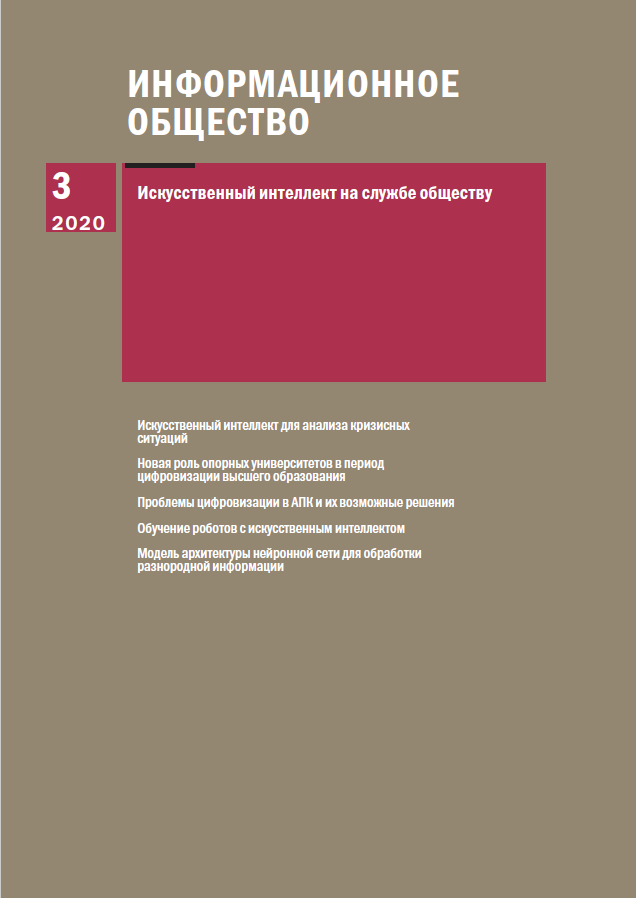
The third issue of the Information Society journal for 2020 has been published

The third issue of the journal for 2020 has been published. It is completely open to reading on a new digital platform (in Russian, with metadata and abstracts in English).

The article by Inna Andreyanova from Pskov State University shows the key problems and prospects of digital transformation of higher education.

The active introduction of ICT into vocational training provides a mechanism for the digital transformation of the educational system. An article by Anna Rozhkova (Pskov State University) is devoted to the development of digital rights and competences of workers in the regions of Russia; alternative forms of employment (temporary, part-time, distance, e-employment and self-employment) are analyzed.

The work of a group of authors from the Institute for System Analysis of Dmitry Chereshkin, Grigory Roizenson and Vladimir Britkov analyzes artificial intelligence (AI) methods from the point of view of their applicability for risk analysis in socio-economic systems (SES). It is proposed to link SES properties, AI methods, as well as risk measurement methods within the framework of building a unified classification.

In the work of Felix Ereshko, Viktor Medennikov and Vladimir Kulba, a scientific approach to the formation of a unified digital platform of the agro-industrial complex based on an appropriate mathematical model is considered. As part of mathematical modeling of the digital platform of the agro-industrial complex, digital standards were obtained that are common to all sectors of the economy. The proposed unified digital platform and digital standards represent cross-cutting management technologies in the agro-industrial complex.

Andrey Kuznetsov and Elena Nikitina (Perm State Research University) consider some problems of Russian universities in connection with the massive use of information technologies and the transition to the digital economy and information society.

Evgeny Bryndin (Research Center “Natural Informatics”, Novosibirsk) present a work, which shows that the implementation of artificial intelligence by a robot is based on the criterion of preferences for accumulated professional and behavioral creative innovative competences and skills.

And, finally, in the work of Alexei Potemkin (Academy of the Federal Security Service, city of Orel), a neural network architecture is proposed for processing heterogeneous information. The proposed architecture includes separate inputs for textual, graphic, tabular, graph and meta information. An experimental study of the efficiency indicators of the developed architecture for solving the problem of identifying information operations on the Internet is carried out.

   

In Russia, with the participation of IIS, a fundamental national standard for big data has been developed

The Technical Committee 164 “Artificial Intelligence”, created on the basis of the Russian Venture Company (RVC), prepared and submitted for public discussion the first edition of the standard “Information Technologies. Big data. Review and Dictionary”. The draft standard was developed by the National Center for Digital Economy of Lomonosov Moscow State University and the Institute of the Information Society.

Standard “Information Technologies. Big data. Review and Glossary” establishes terms and definitions of basic concepts in the field of technologies for working with big data. The use of such technologies is relevant in the telecommunications sector, banking, energy, healthcare and other industries. Without using large arrays of accumulated data, it is impossible to develop artificial intelligence technologies, new production technologies, build digital twins for smart industries, and create smart cities.

The standard is intended to provide mutual understanding between stakeholders – government, business, academia and civil society – in the ​​”big data” subject area.

The national standard is part of a series of national standards harmonizing international documents in the field of big data and is identical to the provisions of the current international standard ISO / IEC 20546: 2019 Information technology – Big data – Overview and vocabulary.

“Today technologies for working with big data have reached a high level of maturity, their application brings tangible effects in various sectors of the economy and areas of the social sphere. The standardization of the development and use of technologies for storing and analyzing big data allows you to exchange best practices, use approaches and solutions that have proven their effectiveness both in Russia and around the world,” said Yuri Hohlov, Chairman of IIS Board of Directors, convenor of the Big Data Working Group of Standardization Technical Committee “Artificial Intelligence” (TC 164).

The draft standard is available at https://www.bigdata-msu.ru/standards/. Comments on the project are accepted by e-mail bigdata-wg02@digital.msu.ru within two months from the date of publication.

Based on materials: https://www.rvc.ru/press-service/news/company/155260/


The second issue of the Information Society journal for 2020 is published

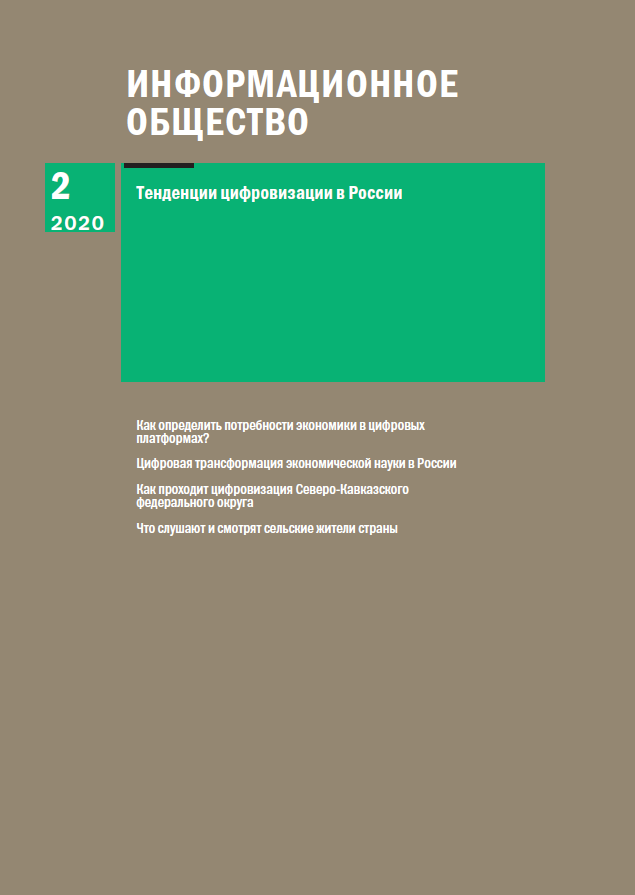
The second issue of the journal for 2020 has been published. It is completely open to reading on a new digital platform (texts in Russian with English metadata and abstracts).

The work of a group of Moscow authors Tatiana Ershova, Alexander Raikov and Yuri Hohlov is aimed at building a system for monitoring the needs of the real economy in digital technologies and platforms. An approach to formalized needs assessments based on the terminology of the user domain and automated real-time market tracking is proposed. The article by Walfried Treyer, Doctor of Technical Sciences, examines the place and forms of placing digital platforms in the organizational structure of the “digital economy”. Doctor of Economics from Nalchik Gumar Batov explores the peculiarities of the formation and development of the digital infrastructure of the North Caucasus Federal District.

The article by Maxim Yurevich, Natalya Ekimova and Evgeny Balatsky is devoted to the study of new promising trends in economics related to digitalization processes (the use of big data, artificial intelligence, machine learning). Natalia Elchaninova investigates the legal issues of ensuring the security of critical information infrastructure.

The article by Anastasia Dobronravova and Varvara Chumakova discusses the features of media literacy of rural residents of Russia based on data collected in 5 field expeditions to rural areas in 2012-2018 (Kostroma region, Rostov region, Republic of Tatarstan, Irkutsk region, Tambov region).

The article by Yulia Lektorova and Andrey Prudnikov presents the experience of a regional high-tech company, one of the world’s top 100 startups, in the field of communication promotion of an IT product in a highly competitive environment.

The scientific article by Anna Shirokanova and Olesya Volchenko is devoted to the problem of the attitude of residents of European countries to the state monitoring of the public space online and electronic personal correspondence.


Yuri Hohlov ranked seventh in the first public rating of experts in the digital economy

For Russia, the digital economy is becoming one of the development priorities. The digitalization trend is recorded at various levels of public authority, and the importance of a technological breakthrough is becoming an integral part of the governance discourse. The speed of the digital economy development makes it one of the most dynamic industry, the slightest lag in it now can provoke a chain reaction and lead to global development problems in the future.

The unsatisfactory results of the previous government on the implementation of the “digital economy” national project led not only to a change of persons responsible for it, but also provoked a discussion about a possible change in the national project itself.

The specificity of the field, its rapid development and the obvious crisis significantly increase the importance of expert knowledge on the digital economy, which can help overcome the gap that has arisen.

The Center for Current Politics, commissioned by the Expert Institute for Social Research, compiled a rating of experts in the field of digital economy.

The Expert Demand Index, developed by the Center for Current Politics, includes 4 criteria: mention, recognition, popularity, assessment.

Due to the high density of assessments among experts in the field of the Digital Economy, the determining factor (in the case of absolute equality of assessments) was the number of publications mentioning the expert in the media.

The rating of experts does not include persons who make government and / or political decisions (officials, deputies, heads of government agencies) in the industry under study, despite the fact that they may fall under the definition of an expert. The only exceptions are those subjects that were repeatedly noted by the expert community during the survey.

Yuri Hohlov, Chairman of the IIS Board of Directors, took 7th place in the rating. Congratulations to Yuri Evgenievich, and, we wish him to further strengthen his personal prestige and the prestige of the Institute of the Information Society!

Source: https://cpkr.ru/issledovaniya/budushchee/reyting-ekspertov-v-sfere-tsifrovoy-ekonomiki/?sphrase_id=907 (in Russian).


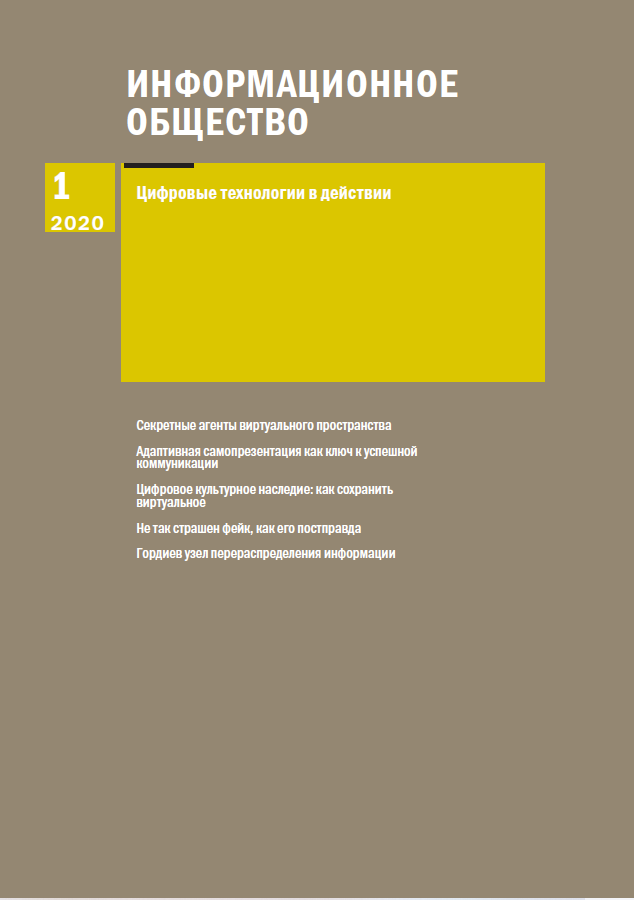
The first issue of the Information Society journal for 2020 is published

In 2020, the publication of the scientific and analytical journal “Information Society” is fully transferred to the online format. It is in this format that the first issue of the journal for 2020 was published. It is completely open to reading on a new digital platform (texts in Russian with English metadata and abstracts).

Inna Lola and Murat Bakeev from the Higher School of Economics presented the results of a study of digital activity with an assessment of the intensity of digital transformation of Russian manufacturing enterprises based on the generalized opinions of entrepreneurs and managers regarding the introduction of digital technologies in production sector.

Yulia Stakhovskaya, representing Tomsk State University, put forward and confirmed a hypothesis about the connection between the strategy of self-presentation of representatives of the digital generation and the context of the Russian social networks, each having its own unique culture of communication. The article by Yulia Koblova from the Saratov Socio-Economic Institute examines the specifics of the formation of virtual space in the modern information-network economy. The motives of the activity of virtual space agents, based on the established values ​​of the Internet, are described, and the features of behavioral practices are also revealed. An article by Viktor Naumov and Svetlana Lyalkova (Dentons) is devoted to the issue of legal protection of digital cultural heritage.

Andrey Druzhinin (Academy of Media Industry) conducted a comprehensive study of the problem field associated with the work of news aggregators. The article by Alexander Efanov (National Research University Higher School of Economics) analyzes the so-called “Laws on fake news” adopted in 2019 and its main methodological collisions. Authors from Novosibirsk State University – Yulia Otmakhova, Dmitry Devyatkin, Alexey Kreskin and Natalya Usenko – identify key centers of competence in radiation technologies for irradiation of food and raw materials, using methods of full-text search, analysis of publications and patent analysis of Russian and foreign patents.

Polad Heydarov from the Institute of Systems Management of the National Academy of Sciences of Azerbaijan proposes the creation of a system where all information from all purchases and buyer’s data will be sent to a single center and stored in a single database for subsequent use of these data in various other areas of government activity.